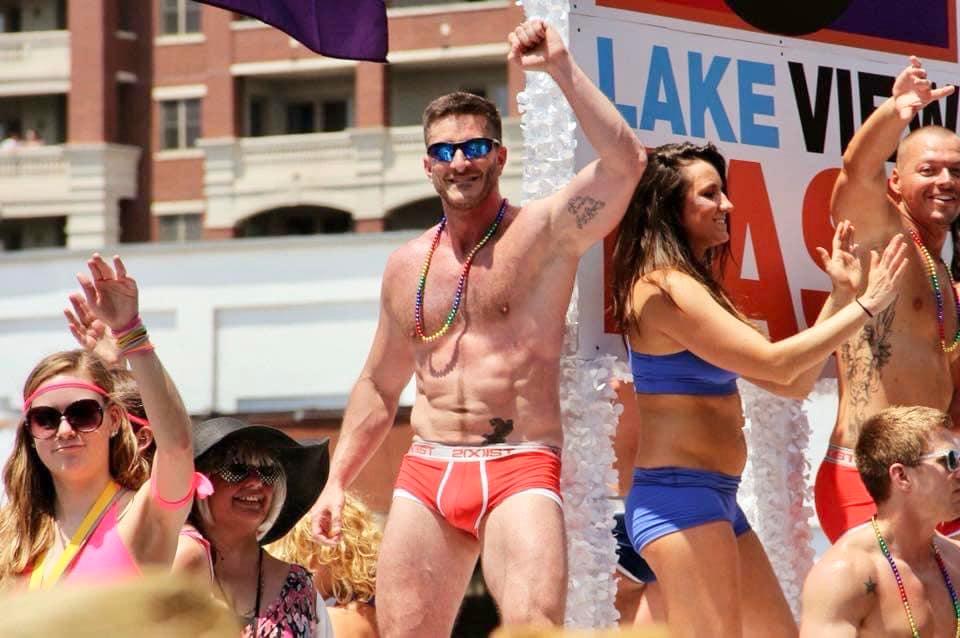
We’re proud because despite decades and decades of relentless persecution everywhere we turn—when organized religion viciously attacks and censures and vilifies us in the name of selective morality, when our families disown us, when our elected officials bargain away our equality for hate votes they try to disguise as so-called “religious liberty,” when the entire Republican party perpetually enshrines a pledge to strip us of our legal equalities in its national platform, when communities and cities and entire states keep trying to codify our families into second-class citizenship, when small-importance bakers with the backing of the big-money hate industry take their unhinged loathing of us all the way to the Supreme Court, when our employers fire us, when our landlords evict us, when our police harass us, when our neighbors and colleagues and fellow citizens openly insult and condemn and mock and berate and even beat and kill us—we continue to survive.
We’re proud because pride is the opposite of shame—and despite what systemic bigotry and the ugliest sides of organized religion work so hard to make the world believe, there is nothing shameful about being gay.
We’re proud because—thanks to the incredible bravery shown by gay people who lived their lives openly sometimes to the point of being defiantly in the decades before us—we can live our lives more and more openly at home, at work, with our families, on social media … and even on national television.
We're proud because we've worked tirelessly to achieve legal equality in marriage, adoption, parental rights and many other ways that make our families recognized as Families in our states and across our country. And though we have much more to accomplish—and though bigotry disguised as morality and religion and the supposed mandates of constituents work and sometimes succeed at eroding our newfound equalities—we have the momentum and intelligence and motivation and humanity and ability to keep driving back the hate as we continue to drive forward with both our newfound and future equalities.
We’re proud because in just the last few years an openly gay married man was a long-viable, highly qualified, unquestionably respected candidate in the Democratic presidential primaries—something most of us never even considered would EVER happen—and not only does he continue to enjoy enthusiastic support across the Democratic party, but leading Republicans seem to have learned that while they can attack him for reasons they’d attack any other candidate, attacking him for being gay is completely unacceptable.
We’re proud because through our tireless work and the prevailing powers of common sense and compassion, Don’t Ask Don’t Tell and Proposition Hate and the so-called Defense of Marriage Act long ago collapsed onto their illogical, immoral, meritless foundations … and new legislative attempts to dehumanize us—especially during election cycles—gain little to no traction or visibility and soon die on the trash heap as well.
We’re proud because we are smart enough to overcome the self-loathing that our venomous, mindlessly theocratic society forces on us, and we have the power to stop its destructive cycle by fighting back and by making intelligent choices involving sex and drugs and money and careers and relationships and the way we live our lives—and by using our lives as examples of success and humanity and love that other gay people can see and respect and emulate and achieve more and more easily.
We’re proud because after all we’ve been through, the world increasingly continues to notice and respect us and enthusiastically appropriate the often fabulous culture we’ve assembled from the common struggles and glorious diversity of our disparate lives.
We’re proud because more and more often and in more and more contexts our country and our culture see the fact that we’re gay as unthreatening and commonplace and frankly boring.
We’re proud because our tireless efforts to be seen have engendered (which is the perfect verb in this context) massive visible support for us with rainbows and Pride messages on everything from clothing to flags to television commercials—and while we can legitimately be worried that companies are merely riding the Pride wave for profit, we can also celebrate that the explosions of these rainbows on our apparel and flags and televisions overwhelmingly normalizes the understanding that we have a place at the table and a presence in our communities.
We’re proud because especially during this past Pride month and always all year we’re celebrating with parties and street fairs and parades—all mostly virtual in 2020 and 2021—that are overflowing with drag queens, leather queens, muscle queens, dad-bod queens, glitter queens, nonbinary queens, you’d-never-know-they-were-queens queens, people who prefer not to be called queens and even straight-but-honorary-queens-for-a-day queens, and together we can see beyond the pride in the parades of our lives and together celebrate the underlying Pride in the parades of our lives.
We’re proud because 57 years ago a small crowd in a bar in New York City reached the tipping point in putting up with endless harassment and oppression and instigated a violent retaliation to a police raid that escalated to a week of riots and then to a march for equality that grew unstoppably to a national movement for equality and respect that continues proudly to this day.
Quite simply, we’re proud that we have so incredibly much to be proud of.
Showing posts with label Gay. Show all posts
Tuesday, June 30, 2026
Saturday, June 27, 2026
Floating through Chicago Pride
I didn’t really know anybody by the time the first pride parade happened soon after I moved to Chicago. So I went by myself to watch it. And, standing among thousands and thousands of cheering, smiling, happy, proud people who were watching with groups of friends and waving at other friends who squeezed by on the crowded sidewalks, I never felt more alone.
It was actually so devastating in my mind that pride weekend literally filled me with dread for the next 15 years I lived in Chicago.
I did notice that first year that the people dancing and waving on the floats looked very happy—and they didn’t have to be surrounded by friends or even anybody as they enjoyed the parade from their glorified perches. So I made up my mind that I needed to make the connections to get myself on a float by the next pride parade.
As I slowly—finally!—made Chicago friends and watched the next few parades with them, I still harbored an irrational, unshakable dread that I’d lose them—or they’d actually leave me—and I’d be alone all over again in the crowds. So I kept trying to figure out how to get myself on a float.
Then! Finally! I got on a float! And let me tell you: Though standing in a Speedo sucking in your abs and holding on for dear life on a lurching, frequently stopping vehicle technically sucks all the fun out of it, having hundreds of millions (in my fantasies my math says I have hundreds of millions of adoring fans so shut up) of people screaming and cheering for you is ALMOST as awesome as dancing and waving high on a moving platform where the cooling breezes are plenty, the jostling crowds are penned up on the sidewalks below you and the scenery changes by the second to keep everything interesting.
Plus you get to dance to your favorite disco hits.
I got myself onto many more floats for the rest of my years in Chicago. The weather was always perfect, my cheering, adoring fans swelled into the billions (shut up), and the joy and pride were always plenty. And my irrational dread—though never gone—was always in check.
Tomorrow is Chicago’s Pride parade. My Facebook and Instagram feeds are already filled with joyful, excited, rainbow-colored pictures of my Chicago friends and acquaintances already celebrating, and while I’m thrilled and proud to have (eventually) been a part of those traditions, our dramatically more subdued Cedar Rapids Pride festivals are now WAY more my speed. And not my Speedo.
So I wish all of you celebrating Pride in Chicago and everywhere else—whether on the sidewalks or on a float—an awesome day and an awesome experience both personally and with everyone around you. I’ll be folding laundry and digging in my garden and tackling DIY projects and running whatever miles my knees will allow in a vain attempt to not stray too far from my underwear-on-a-float body.
It was actually so devastating in my mind that pride weekend literally filled me with dread for the next 15 years I lived in Chicago.
I did notice that first year that the people dancing and waving on the floats looked very happy—and they didn’t have to be surrounded by friends or even anybody as they enjoyed the parade from their glorified perches. So I made up my mind that I needed to make the connections to get myself on a float by the next pride parade.
As I slowly—finally!—made Chicago friends and watched the next few parades with them, I still harbored an irrational, unshakable dread that I’d lose them—or they’d actually leave me—and I’d be alone all over again in the crowds. So I kept trying to figure out how to get myself on a float.
Then I joined the Chicago Gay Men’s Chorus. And we marched in the parade! But not on a float. And I very very stupidly decided to wear my rollerblades and they hurt and I was bad at stopping so I kept running into people and I was so miserable I had to hobble home the moment it was over so I couldn’t hang out and celebrate with anyone afterward so as far as I’m concerned the whole experience didn’t count and I don’t want to talk about it.
Then! Finally! I got on a float! And let me tell you: Though standing in a Speedo sucking in your abs and holding on for dear life on a lurching, frequently stopping vehicle technically sucks all the fun out of it, having hundreds of millions (in my fantasies my math says I have hundreds of millions of adoring fans so shut up) of people screaming and cheering for you is ALMOST as awesome as dancing and waving high on a moving platform where the cooling breezes are plenty, the jostling crowds are penned up on the sidewalks below you and the scenery changes by the second to keep everything interesting.
Plus you get to dance to your favorite disco hits.
I got myself onto many more floats for the rest of my years in Chicago. The weather was always perfect, my cheering, adoring fans swelled into the billions (shut up), and the joy and pride were always plenty. And my irrational dread—though never gone—was always in check.
Tomorrow is Chicago’s Pride parade. My Facebook and Instagram feeds are already filled with joyful, excited, rainbow-colored pictures of my Chicago friends and acquaintances already celebrating, and while I’m thrilled and proud to have (eventually) been a part of those traditions, our dramatically more subdued Cedar Rapids Pride festivals are now WAY more my speed. And not my Speedo.
So I wish all of you celebrating Pride in Chicago and everywhere else—whether on the sidewalks or on a float—an awesome day and an awesome experience both personally and with everyone around you. I’ll be folding laundry and digging in my garden and tackling DIY projects and running whatever miles my knees will allow in a vain attempt to not stray too far from my underwear-on-a-float body.
So happy Pride to all of us!
Tuesday, October 20, 2020
Today's Moment Of Pure Ridiculous Joy: "I Just Wanna Fuckin' Dance"
Fun fact: There is a 2001 three-act opera exploring, parodying, mocking and even sympathizingly understanding the cultural underpinnings and social normalizations of The Jerry Springer Show. It is called (if you can even believe this name wasn’t already taken) Jerry Springer: The Opera.
Its breakout song—at least for gay men at massive circuit parties in the early 2000s—was “I Just Wanna Fuckin' Dance,” in which a stripper who is done being belittled and called a whore takes ownership of the actions and choices her circumstances have offered her and proclaims “I’m tired of all this trying / I wanna do some living / ‘Cos I’ve done enough dying / I just wanna dance / I just wanna fucking dance!”
Yes, there is swearing. It’s about JERRY SPRINGER.
But back to us gays and our massive circuit parties (which are massively massive dance parties with laser light shows, rampant shirtlessness, speakers the size of industrial refrigerators and deafening remixes of awesome dance songs, with the exception of Madonna’s appalling rendition of “Don’t Cry For Me, Argentina,” which is in every conceivable way the polar opposite of awesome and you are to NEVER MENTION AGAIN). Anyway, we gays OF COURSE made many deafening remixes of “I Just Wanna Dance,” which is an awesome dance song. Plus it’s about wanting to dance. TOTAL TWOFER.
Speaking of twofers, here’s a super-awesome remix (though we're now long past the 15th anniversary) paired with dance clips from every awesome genre of awesome movie musical from Sweet Charity to Xanadu. IT. IS. SO. AWESOME. Watch it. Love it. Sing along with it. If it doesn’t make you wanna be gay, it will at the very least make you wanna dance. I mean wanna FUCKIN' dance!
Its breakout song—at least for gay men at massive circuit parties in the early 2000s—was “I Just Wanna Fuckin' Dance,” in which a stripper who is done being belittled and called a whore takes ownership of the actions and choices her circumstances have offered her and proclaims “I’m tired of all this trying / I wanna do some living / ‘Cos I’ve done enough dying / I just wanna dance / I just wanna fucking dance!”
Yes, there is swearing. It’s about JERRY SPRINGER.
But back to us gays and our massive circuit parties (which are massively massive dance parties with laser light shows, rampant shirtlessness, speakers the size of industrial refrigerators and deafening remixes of awesome dance songs, with the exception of Madonna’s appalling rendition of “Don’t Cry For Me, Argentina,” which is in every conceivable way the polar opposite of awesome and you are to NEVER MENTION AGAIN). Anyway, we gays OF COURSE made many deafening remixes of “I Just Wanna Dance,” which is an awesome dance song. Plus it’s about wanting to dance. TOTAL TWOFER.
Speaking of twofers, here’s a super-awesome remix (though we're now long past the 15th anniversary) paired with dance clips from every awesome genre of awesome movie musical from Sweet Charity to Xanadu. IT. IS. SO. AWESOME. Watch it. Love it. Sing along with it. If it doesn’t make you wanna be gay, it will at the very least make you wanna dance. I mean wanna FUCKIN' dance!
Tuesday, October 6, 2020
Movies: The Boys in the Band
I tried. Again. But the plot has way too many illogical stupidities. And I quit within the first hour.
I get how it was groundbreaking 50 years ago when it put gay men front and center in a narrative that didn’t play us as one-dimensional faggot stereotypes. And I appreciate that it let the gay characters be messy and imperfect and complicated and unlikable for reasons any other character in any other narrative could be unlikable.
But the conceit driving the entire plot was illogical then and it’s illogical now—and we’re no longer in a zeitgeist where gays are so desperate for representation that we’re slavishly thankful for sloppy pop culture just because it mentions us.
Maybe in another 50 years a director or screenwriter will find a plausible way to keep nine arguably unhappy people from en-masse leaving a hostile, toxic, physically violent birthday party before the end of the first act. Until then, I’ll just appreciate the fact that this revival appeared on Broadway and now in this movie starring all out gay actors, many of whom are relatively famous. And for that, I am indeed slavishly thankful.
I get how it was groundbreaking 50 years ago when it put gay men front and center in a narrative that didn’t play us as one-dimensional faggot stereotypes. And I appreciate that it let the gay characters be messy and imperfect and complicated and unlikable for reasons any other character in any other narrative could be unlikable.
But the conceit driving the entire plot was illogical then and it’s illogical now—and we’re no longer in a zeitgeist where gays are so desperate for representation that we’re slavishly thankful for sloppy pop culture just because it mentions us.
Maybe in another 50 years a director or screenwriter will find a plausible way to keep nine arguably unhappy people from en-masse leaving a hostile, toxic, physically violent birthday party before the end of the first act. Until then, I’ll just appreciate the fact that this revival appeared on Broadway and now in this movie starring all out gay actors, many of whom are relatively famous. And for that, I am indeed slavishly thankful.
Friday, April 13, 2018
Theater program notes: Kinky Boots
Published April 13, 2018, for the Broadway national tour of Kinky Boots at the University of Iowa's Hancher Auditorium.
Dragging drag into the spotlight: What does it mean beyond falsies and fierceness?
By Jake Stigers
“We’re born naked, and the rest is drag.”
This famous—well, famous to those of us who pay attention to such things—quote by RuPaul in her 1996 book Lettin it All Hang Out: An Autobiography defined a new sensibility of and modern perspective on the evolution of drag writ large in a culture where it has exploded from gay-bar entertainment to mainstream art form. RuPaul is, of course, the towering, flawless-skinned doyenne of the reality show RuPaul’s Drag Race, which has enjoyed nine blindingly sequined seasons pitting expertly contoured drag-queen contestants against each other in a lip-synching-for-their-lives battle to be crowned America’s Next Drag Superstar.
So what exactly is drag?
Before we go any further, I want to make some distinctions: Drag queens, as you’re about to see in Kinky Boots, are essentially—and this paragraph is written in very general terms to provide very basic information for people who might not possess this understanding—men who dress as women for the sake of performing. They are different from transvestites, who are men (or women) who for any number of reasons enjoy dressing as women (or men) in private or in public. And transsexuals are people who feel that they were born the wrong gender and who undergo any degree of transformations from basic outward appearance to hormone therapy to surgery to change their genders … and then usually dress and live as completely as possible in those new genders.
Also before we go any further, I—your tall, not-at-all-petite writer—also want to offer some of my drag bona fides: I have dressed in drag on stage (I once rocked a black leotard and heels playing Velma Kelly in a loving re-creation of Chicago’s “Cell Block Tango” with the Chicago Gay Men’s Chorus), I have dressed in drag in public (I attended a Christmas-drag-mandatory birthday party populated by ten sturdy, ridiculously-not-pretty drag queens dressed in various degrees of red-and-green tragedy at an otherwise respectable restaurant), I have dressed in drag at home (because walking fiercely in heels doesn’t just happen by magic), and given this vast experience in the drag world I eventually decided I needed my own drag name (Porcelain Bidet, thanks for asking).
So back to our question: What exactly is drag?
In the current popular-culture definition—and, again, in Kinky Boots—drag is men dressing and performing as women not to try to be women but to celebrate and elevate and experience the inherent fabulousness of women. And these men do drag for any number of reasons: Performing only as men is limiting, breaking gender constructs is subversive and provocative, bringing out an inner diva is both liberating and fierce, being a drag queen is just another role to play for an actor or singer or dancer … or sometimes men do drag just because it’s a whole lot of fun. Aside from wearing heels, of course. Because ouch. Ouch ouch ouch. Ouch.
You can even parse drag into any number of subsets:
We can also delineate a difference between drag on a stage and drag in public. While stage drag is about creating a character or performing as an idealized persona, drag in public—which, again, is entirely different from cross-dressing as a transvestite to feel comfortable or as a transexual person in an effort to achieve some level of “passing”—is usually done in the spirit of dressing in a costume just to have fun … or even perhaps to provoke a person-to-person response from people.
If we look at drag as something that provokes a response or makes an impression, it can mean practically anything. If I—a man who defaults to T-shirts, cargo shorts and old running shoes whenever possible—walk down the street instead in a black suit or a Santa hat and a red Speedo or a bunny outfit or a marabou-trimmed sweater and a skirt made from a repurposed poinsettia tablecloth—all of which I have done—I’m essentially wearing a costume that influences people either consciously or unconsciously to see—and react to—me in a certain way. Again: We’re born naked, and the rest is drag.
And then there’s the matter of what constitutes women’s clothing and what constitutes men’s clothing at any point in time. A mere 250 years ago, America’s Founding Fathers—like all their gentlemen contemporaries—wore heels, stockings and curled wigs ... all of which are articles of dress that only America’s mothers—and daughters and all women, of course, but I’m trying to use a clever father-mother parallel here—conventionally wear today. So at what point did these modes of dress cease to be men’s, start to be women’s, and then become iconic and fabulous enough to be appropriated by drag queens?
The cultural history of what constitutes drag for women doesn’t offer a clear parallel distinction, though; from a modern gender-conforming perspective, men wear pants and women wear dresses. But women also wear pants. Though it wasn’t always this binary. There were American laws enacted as recently as 1907 that forbade women from wearing trousers in public. It wasn’t until Marlene Dietrich was splashed all over the fan magazines wearing a black tuxedo to a 1932 movie premiere that attitudes toward women in pants started to shift; a year later, Eleanor Roosevelt presided over the Easter Egg Roll on the White House lawn wearing riding pants, and Vogue magazine published its first photos of women wearing slacks in 1939. And even though professional women were wearing menswear-inspired pants and suits by the 1970s, it wasn’t until 1993—that’s not a typo—that women were allowed to wear trousers on the U.S. Senate floor. (That last bit of information doesn’t really pertain to this narrative, though. I just stumbled on it in my research and found it flabbergasting enough that I thought it was worth sharing.)
Anyway, for the last half-century, women have been wearing menswear-style clothing in both casual and formal settings. So drag kings—women dressing and sometimes performing as the male counterparts to drag queens—have to be more and more diligent (and creative) in defining their drag-king personas.
It is at this point that a thorough, responsible researcher and writer would incorporate into his narrative the gender-appropriating fads of man-buns, guyliner and George Michael’s hair in his WHAM! years. I, however, will not.
So take a moment to look past the drag queens and their stories in Kinky Boots and notice the other characters and what they wear … and how it influences—or is influenced by—their stories. Then think about the story you tell every time you choose something to put on. Because even if it doesn’t include sequins or break the bounds of gender conformity, it would be a total drag if you didn’t celebrate the story it tells about you.
Jake Stigers is a writer, editor, blogger and performer living in Cedar Rapids. Porcelain Bidet is now permanently retired from performing and resides in a box somewhere in the attic.
Dragging drag into the spotlight: What does it mean beyond falsies and fierceness?
By Jake Stigers
“We’re born naked, and the rest is drag.”
This famous—well, famous to those of us who pay attention to such things—quote by RuPaul in her 1996 book Lettin it All Hang Out: An Autobiography defined a new sensibility of and modern perspective on the evolution of drag writ large in a culture where it has exploded from gay-bar entertainment to mainstream art form. RuPaul is, of course, the towering, flawless-skinned doyenne of the reality show RuPaul’s Drag Race, which has enjoyed nine blindingly sequined seasons pitting expertly contoured drag-queen contestants against each other in a lip-synching-for-their-lives battle to be crowned America’s Next Drag Superstar.
So what exactly is drag?
Before we go any further, I want to make some distinctions: Drag queens, as you’re about to see in Kinky Boots, are essentially—and this paragraph is written in very general terms to provide very basic information for people who might not possess this understanding—men who dress as women for the sake of performing. They are different from transvestites, who are men (or women) who for any number of reasons enjoy dressing as women (or men) in private or in public. And transsexuals are people who feel that they were born the wrong gender and who undergo any degree of transformations from basic outward appearance to hormone therapy to surgery to change their genders … and then usually dress and live as completely as possible in those new genders.
Also before we go any further, I—your tall, not-at-all-petite writer—also want to offer some of my drag bona fides: I have dressed in drag on stage (I once rocked a black leotard and heels playing Velma Kelly in a loving re-creation of Chicago’s “Cell Block Tango” with the Chicago Gay Men’s Chorus), I have dressed in drag in public (I attended a Christmas-drag-mandatory birthday party populated by ten sturdy, ridiculously-not-pretty drag queens dressed in various degrees of red-and-green tragedy at an otherwise respectable restaurant), I have dressed in drag at home (because walking fiercely in heels doesn’t just happen by magic), and given this vast experience in the drag world I eventually decided I needed my own drag name (Porcelain Bidet, thanks for asking).
So back to our question: What exactly is drag?
In the current popular-culture definition—and, again, in Kinky Boots—drag is men dressing and performing as women not to try to be women but to celebrate and elevate and experience the inherent fabulousness of women. And these men do drag for any number of reasons: Performing only as men is limiting, breaking gender constructs is subversive and provocative, bringing out an inner diva is both liberating and fierce, being a drag queen is just another role to play for an actor or singer or dancer … or sometimes men do drag just because it’s a whole lot of fun. Aside from wearing heels, of course. Because ouch. Ouch ouch ouch. Ouch.
You can even parse drag into any number of subsets:
Comedic drag, like comedian Harvey Korman cross-dressing just to be silly in a decade of skits on The Carol Burnett Show.
Tragic drag, like actor Harris Glenn Milstead’s inspiredly disturbing drag character—and director John Waters’ muse—Divine in movies like 1974’s Female Trouble.
Gimmick drag, where men play women less for plausibility and more to drive wacky-hijinks plotlines, like Tony Curtis and Jack Lemmon unconvincingly donning frocks to escape the mafia in the 1959 movie Some Like it Hot, or Tom Hanks and Peter Scolari gussying up to save on rent in a not-very-observant-girls-only apartment building from 1980 to 1982 in the mercifully short-lived TV show Bosom Buddies.
Fabulous drag, which is an umbrella term for the work of all the men who dress as women, shimmer in the spotlight and reach for the stars in Kinky Boots, RuPaul’s Drag Race, and every gay bar in America with a stage and a good sound system.
We can also delineate a difference between drag on a stage and drag in public. While stage drag is about creating a character or performing as an idealized persona, drag in public—which, again, is entirely different from cross-dressing as a transvestite to feel comfortable or as a transexual person in an effort to achieve some level of “passing”—is usually done in the spirit of dressing in a costume just to have fun … or even perhaps to provoke a person-to-person response from people.
If we look at drag as something that provokes a response or makes an impression, it can mean practically anything. If I—a man who defaults to T-shirts, cargo shorts and old running shoes whenever possible—walk down the street instead in a black suit or a Santa hat and a red Speedo or a bunny outfit or a marabou-trimmed sweater and a skirt made from a repurposed poinsettia tablecloth—all of which I have done—I’m essentially wearing a costume that influences people either consciously or unconsciously to see—and react to—me in a certain way. Again: We’re born naked, and the rest is drag.
And then there’s the matter of what constitutes women’s clothing and what constitutes men’s clothing at any point in time. A mere 250 years ago, America’s Founding Fathers—like all their gentlemen contemporaries—wore heels, stockings and curled wigs ... all of which are articles of dress that only America’s mothers—and daughters and all women, of course, but I’m trying to use a clever father-mother parallel here—conventionally wear today. So at what point did these modes of dress cease to be men’s, start to be women’s, and then become iconic and fabulous enough to be appropriated by drag queens?
The cultural history of what constitutes drag for women doesn’t offer a clear parallel distinction, though; from a modern gender-conforming perspective, men wear pants and women wear dresses. But women also wear pants. Though it wasn’t always this binary. There were American laws enacted as recently as 1907 that forbade women from wearing trousers in public. It wasn’t until Marlene Dietrich was splashed all over the fan magazines wearing a black tuxedo to a 1932 movie premiere that attitudes toward women in pants started to shift; a year later, Eleanor Roosevelt presided over the Easter Egg Roll on the White House lawn wearing riding pants, and Vogue magazine published its first photos of women wearing slacks in 1939. And even though professional women were wearing menswear-inspired pants and suits by the 1970s, it wasn’t until 1993—that’s not a typo—that women were allowed to wear trousers on the U.S. Senate floor. (That last bit of information doesn’t really pertain to this narrative, though. I just stumbled on it in my research and found it flabbergasting enough that I thought it was worth sharing.)
Anyway, for the last half-century, women have been wearing menswear-style clothing in both casual and formal settings. So drag kings—women dressing and sometimes performing as the male counterparts to drag queens—have to be more and more diligent (and creative) in defining their drag-king personas.
It is at this point that a thorough, responsible researcher and writer would incorporate into his narrative the gender-appropriating fads of man-buns, guyliner and George Michael’s hair in his WHAM! years. I, however, will not.
So take a moment to look past the drag queens and their stories in Kinky Boots and notice the other characters and what they wear … and how it influences—or is influenced by—their stories. Then think about the story you tell every time you choose something to put on. Because even if it doesn’t include sequins or break the bounds of gender conformity, it would be a total drag if you didn’t celebrate the story it tells about you.
Jake Stigers is a writer, editor, blogger and performer living in Cedar Rapids. Porcelain Bidet is now permanently retired from performing and resides in a box somewhere in the attic.
Subscribe to:
Posts (Atom)
Art: Skeletons Fighting Over a Pickled Herring, James Ensor
At first glance, James Ensor's 1891 Skeletons Fighting Over a Pickled Herring is perhaps a silly take on Halloween imagery. Or an homag...
-
“Don’t read Dear Edward on a plane!” a friend warned me. But I’d packed four books for my weeklong trip to Colombia and I’d finished the ot...
-
Nine years ago today—two years after leaving the hospital and just hours after taking the very first dose of yet another new bipolar med add...
-
Next to Normal —a searing, brilliant, Pulitzer-winning rock opera examining the lives of a family whose mother is desperately struggling wit...